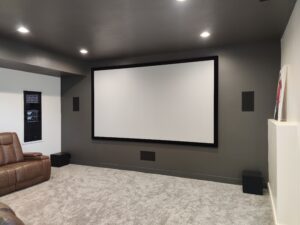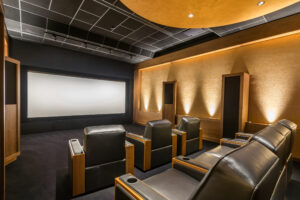


If you’ve been researching home theater systems lately, you’ve probably come across the term Dolby Atmos. Maybe you’ve seen it listed on a new AV receiver, mentioned in a movie’s audio description, or experienced it in a friend’s media room where the sound felt different from anything you’d heard before. Dolby Atmos has become the gold standard for immersive audio in home theaters, but the marketing around it can make it hard to figure out what’s actually new, what’s worth investing in, and whether you really need it for your space. In this post, we’ll break down what Dolby Atmos is, how it works, how it differs from traditional surround sound, what you need to get it running at home, and whether it’s the right fit for your room and the way you watch. By the end, you’ll have a clearer picture of whether Atmos belongs in your home theater plans or whether a more traditional surround setup is the smarter call for your space.
What Is Dolby Atmos?
Dolby Atmos is an immersive audio format developed by Dolby Laboratories that adds a sense of height and three dimensional placement to movie and music soundtracks. It was first introduced for commercial cinemas in 2012 and has since made its way into home theaters, soundbars, headphones, and streaming platforms. The basic idea is simple. Instead of locking sounds into a fixed number of speaker channels, Atmos treats individual sounds as audio objects that can be placed and moved anywhere in three dimensional space around the listener.
It sounds technical, but the impact is immediate when you hear it. A helicopter doesn’t just sound like it’s coming from the rear speakers. It sounds like it’s actually flying over your head, then off to the side, then fading into the distance. Rain doesn’t just play through the surrounds. It feels like it’s falling from above. The result is an audio experience that matches what your eyes are seeing on screen with a precision that traditional surround sound simply can’t match.
The format has become widely adopted because the content is there. Major streaming platforms, 4K Blu-ray releases, and even some music services now deliver Atmos mixes natively, which means the upgrade is no longer limited to a small library of demo content.
How Does Dolby Atmos Work?
The core innovation behind Dolby Atmos is something called object based audio. To understand why that matters, it helps to know how older surround sound formats work first.
In a traditional 5.1 or 7.1 setup, every sound in a movie is mixed into a specific channel. The dialogue lives in the center channel. The score might be spread across the front left and right. A car driving past gets panned from the front right speaker to the rear right speaker. The mix engineer is essentially deciding ahead of time which speaker each sound should come from, and the system plays it back exactly that way.
This unlocks a few important things:
- Sounds can move smoothly through the room rather than jumping from speaker to speaker
- Height and overhead placement become possible, not just left-right and front-back
- The same Atmos mix automatically adapts to systems ranging from a basic 5.1.2 setup all the way up to a 9.1.6 dedicated theater
- Mix engineers can place sounds with much more precision, which translates to a more believable soundscape
The result is audio that feels more like a real environment and less like a series of speakers playing different parts of a movie. It’s a meaningful step forward, and once you’ve experienced a well calibrated Atmos system, going back to a flat surround mix can feel like something is missing.
How Is Dolby Atmos Different From Traditional Surround Sound?
The most obvious difference between Dolby Atmos and traditional formats like 5.1 or 7.1 is the addition of height. A standard 5.1 system has five speakers at ear level plus a subwoofer. A 7.1 system adds two more rear surround speakers, still at ear level. Atmos introduces overhead or height speakers to the equation, which adds a dimension that channel based formats can’t reproduce.
You’ll often see Atmos systems described with a three number format like 5.1.2, 7.1.4, or 9.1.6. Here’s how to read those numbers:
- The first number is the count of ear-level speakers
- The second number is the count of subwoofers
- The third number is the count of height or overhead speakers
A 7.1.4 system, for example, has seven ear-level speakers, one subwoofer, and four overhead speakers. The more overhead channels you have, the more precise and immersive the height effects become.
There’s also a meaningful difference in dialogue clarity and spatial separation. Because Atmos can isolate audio objects more precisely, dialogue tends to anchor more firmly in the center of the room while effects move around it. That separation makes movies easier to follow, especially in scenes with heavy ambient sound or complex action.
For some viewers, a well designed 7.1 system already feels like a major upgrade over a soundbar or TV speakers. For others, the addition of overhead audio is the moment a home theater starts to feel like a real cinema.
What Do You Need to Set Up Dolby Atmos at Home?
Getting Dolby Atmos running in a home theater is more involved than swapping out a few speakers, but it doesn’t have to be overwhelming. There are a few core requirements every Atmos system needs.
An Atmos-capable AV receiver or processor. This is the brain of the system. The receiver needs to be able to decode the Atmos signal and route audio objects to the right speakers. Most mid-range and high-end receivers built in the last several years support Atmos, but it’s worth confirming the model and the number of channels it can drive before buying.
Height or overhead speakers. This is the defining piece of an Atmos system. You have two main options. The first is true in-ceiling speakers mounted directly overhead, which is the gold standard for sound quality and placement accuracy. The second is up-firing modules that sit on top of your front and surround speakers and bounce sound off the ceiling. Up-firing modules are easier to install, especially in rooms where you can’t run wires through the ceiling, but they typically don’t deliver the same precision as in-ceiling speakers.
Properly placed surround and ear-level speakers. The height speakers only work as well as the rest of the system. The front, center, surround, and subwoofer placement still matters. Speaker timbre matching across the system also matters because audio objects need to sound consistent as they move between speakers.
Atmos-encoded content and a way to play it. This means a 4K Blu-ray player, a streaming device that supports Atmos pass-through, or a streaming service that delivers Atmos natively. Most modern streaming devices and TVs support this, but it’s worth verifying. Dolby maintains a list of services and platforms that currently carry Atmos content, which is a helpful reference when planning a system.
A calibrated room. Even great equipment can sound flat in a room with bad acoustics. Hard floors, parallel walls, and large glass surfaces can cause reflections and standing waves that muddy the mix. Acoustic treatment, calibration software, and thoughtful room design all play a role in how the system actually sounds.
The last piece is design and integration. A home theater isn’t just speakers and a receiver. Lighting, seating, screen size, viewing distance, and how the whole system is controlled all affect the experience. That’s where professional design starts to make a real difference.
Is Professional Audio Installation Worth It?
For a dedicated theater room or a serious media space, professional installation tends to pay off in ways that go beyond convenience. The custom installation industry has even developed formal guidelines around this. CEDIA’s RP22 Immersive Audio Design Recommended Practice defines specific performance criteria for high-end residential theaters and is the standard most serious integrators design to. A few of the reasons homeowners choose to bring in professionals like AIS.
- Proper speaker placement based on the actual geometry of the room, not just generic guidelines
- In-ceiling speaker installation, which often involves running wire through walls and ceilings
- Acoustic treatment and room calibration that goes beyond what built-in apps can do
- Integration with lighting, shades, and home automation for a true cinematic experience
- Equipment selection that matches the room and the homeowner’s actual viewing habits, not just what’s marketed most aggressively
- Long-term support, system updates, and the ability to troubleshoot when something doesn’t work the way it should
The bigger and more custom the room, the more value professional installation tends to add. A great Atmos system isn’t just a list of components. It’s a designed environment where every piece works together.
Why Homeowners Choose AIS for Custom Dolby Atmos Home Theaters
Dolby Atmos is a different way of mixing and delivering audio that adds real depth and dimension to what you hear in your home theater. Whether you actually need it depends on how you watch, what kind of content you enjoy, the shape and size of your room, and how serious you want your setup to be. For some homeowners, a well-designed 7.1 system already feels like a major upgrade. For others, the height channels and object-based mixing of Atmos make movies, shows, and music feel like an entirely different experience. AIS designs and installs custom home theaters across Northern Utah, including full Dolby Atmos systems with in-ceiling speakers, integrated lighting scenes, and motorized shades for a true cinematic environment. Whether you’re building a dedicated theater room or upgrading your existing space, we’ll help you decide whether Atmos belongs in your plan and design a system around the way you actually use the room. Contact us today or use our budget calculator to plan expenses.