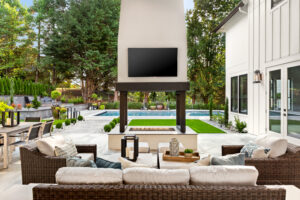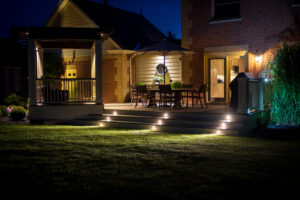

Most decks get their lighting in pieces. A fixture by the back door when the house was built, a string of lights added one summer, a solar stake or two near the stairs. It works, in the sense that you can see, but it never quite looks like the decks people save pictures of. Those decks are lit in layers, with light coming from low and from above, aimed at surfaces rather than at people’s eyes, and tied to a control system so the whole thing comes on at dusk without anyone thinking about it. In this post, we’ll go through lighting best practices and how brightness, color temperature, and control turn a collection of fixtures into a finished space.
Why a Deck Needs a Lighting Plan
The decks that look best at night were planned before a single fixture went in. A lighting plan decides which surfaces get light, how bright each layer is, where the wire runs, and what controls it. Without one, you end up adding fixtures to fix the last fixture, and the deck ends up bright in one corner and dark everywhere else.
Planning also sorts out which deck lighting ideas you can handle yourself and which ones need a professional. Some are a good weekend project. Others involve wiring, power supplies, and code requirements that are worth handing off.
| DIY friendly | Best left to a professional |
| Plug-in string lights and café lights | Hardwired step and riser lights |
| Solar post caps | Low voltage systems with a sized transformer |
| Swapping bulbs for warm white LEDs | Recessed in-deck and under-rail fixtures |
| Moving a lamp or lantern | New outdoor circuits, outlets, or line voltage fixtures |
| Accent stakes | Integration with a smart lighting system |
The dividing line is usually power. Anything that plugs in or runs on its own battery is fair game. Anything that needs a transformer, a new circuit, or wire routed through the deck framing is where a professional design keeps the result reliable and safe.
Lighting the Deck Surface, Stairs, and Railings
The deck itself carries three layers of light, and each one does a different job.
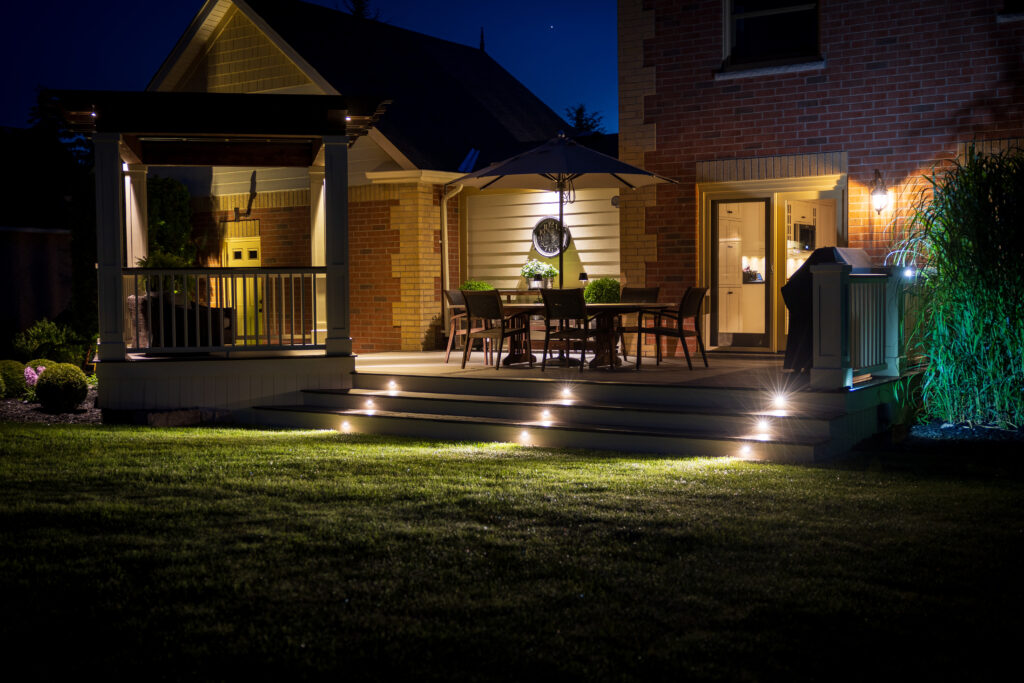
1. Stairs: Stepscome first. They are the one part of a deck where lighting is a safety issue, and building codes generally require exterior stairways to be lit. Riser lights mounted in the vertical face of each step, or small step lights set into the stringer, put light on the tread without shining into anyone’s eyes. Because these are recessed and wired through the framing, they’re a professional installation, and they’re far easier to add before the deck boards go down.
2. Railings: These set the outline. The most popular deck railing lighting ideas use small LED fixtures tucked under the top rail, which wash light down onto the deck boards and over the balusters. Post cap lights add a soft glow at each post, and many composite railing systems now offer matching post cap, under-rail, and riser fixtures designed to integrate cleanly. Solar post caps are an easy DIY upgrade, but they fade on short winter days. Hardwired low-voltage versions stay consistent year-round.
3. The deck surface: This is whatties it together. Recessed in-deck lights mark edges and walkways, and linear lighting under a bench or a built-in planter adds a band of glow that reads beautifully from inside the house. For raised decks, under-deck lighting ideas are worth thinking about too, since downlights mounted to the joists can light the patio or storage space below.
Nearly all of this runs on low voltage landscape lighting. A 12-volt system is safe to run through a deck, but it needs a transformer sized to the total load, and long wire runs lose voltage along the way, so the last fixture on a run can come out noticeably dimmer than the first. Professional installers plan the wire layout and use multi-tap transformers so every fixture receives the voltage it was designed for.
Lighting the Space Around the Deck
A well-lit deck surrounded by total darkness feels like a stage. Lighting a few things beyond the railing gives the eye somewhere to land and makes the deck feel larger.
Trees are the obvious place to start. A pair of uplights at the base of a mature tree creates a focal point that frames the view from the deck. On the other hand, a light mounted high in the canopy and aimed down produces a moonlight effect with soft shadows on the ground. The difference between uplighting and downlighting matters here, and most good designs use both.
Planting beds, garden walls, and the edges of a lawn round it out. Path lights along the route from the deck stairs to the yard help with safety, and low accent lights on shrubs or ornamental grasses add depth without adding glare. Many of the same principles from landscape lighting ideas apply, just scaled to what you can see from the deck.
Lighting around the deck is where DIY projects tend to fall apart. Tree lights need cable buried along a clean route, fixtures that survive freeze and thaw cycles, and a transformer with enough capacity for both the deck and the yard. Designing the deck and landscape lighting as one system avoids two separate transformers and two separate timers that never agree.
Brightness, Color Temperature, and Glare
The fastest way to ruin a deck at night is too much light. Deck fixtures should be soft and layered, with no single fixture carrying the whole space. If the deck feels bright enough to read a newspaper, it’s probably overlit.
Color temperature matters just as much. Warm white light between 2700K and 3000K flatters wood, skin, and plants, and it matches the interior lighting most homes already use. Cooler light around 4000K and up looks harsh outdoors and makes a deck feel like a parking lot. Warm sources and fully shielded fixtures are also two of the core principles of good outdoor lighting. The biggest mistake with LED deck lighting ideas is mixing bulbs from different brands, since one fixture at 2700K next to another at 4000K is instantly noticeable.
Glare is the third factor. Every fixture should light a surface, not a person’s face. Shielded step lights, down-facing rail lights, and properly aimed uplights keep the source hidden. Responsible home outdoor lighting also means aiming light where it’s useful and not into a neighbor’s bedroom window.
Modern LEDs make all of this efficient, which is what makes leaving a deck lit every evening practical. A professional design uses fixtures with matching color temperature and output, so the whole deck reads as one consistent layer of light.
Bringing It Together with Smart Control
A deck lighting design only feels finished when it runs itself. The simplest step is an astronomical timer, which turns lights on at sunset and adjusts automatically as the seasons change, so nobody has to reset a clock in November.
Smart lighting control takes it further. Scenes let one button set the deck for a dinner party, a late-night fire, or security, with each layer dimmed to the right level. Lutron systems can tie deck and landscape lighting into the same keypads and app as the lights inside. Also, landscape lighting can be connected to your smart home system to respond to motion, arrival, or a vacation schedule.
This is the one part of deck lighting that’s almost entirely professional work, since it involves dimmable transformers, wired keypads, and programming across the whole home. It’s also where the difference between a lit deck and a designed one becomes obvious, and where hiring pros over DIY automation pays off most, since everything turns on, dims, and shuts off together.
Light Your Deck with AIS
A deck that looks good after dark is rarely the result of one bright fixture. It comes from layering light at different heights, keeping the source out of people’s eyes, holding a consistent warm color temperature, lighting a few things beyond the deck so the yard does not turn into a black wall, and putting all of it on a control system that handles dusk on its own. Those choices are easier to make before the deck is built or refinished, though most of them can still be retrofitted well. AIS designs and installs landscape and deck lighting across Northern Utah, including low-voltage lighting design, smart lighting control, and whole-home automation so the outside of your home behaves like the inside. If you are planning a deck project this season, contact us today and take a look at our budget calculator while you are thinking through scope.