
Acoustic panels are sound-absorbing surfaces you mount on the walls and ceiling of a room to soak up reflections before they reach your ears. They exist because rooms color sound, and a great speaker in a bad room will always sound worse than a good speaker in a well-treated one. Does that mean your theater needs them? Will they actually keep noise from waking the rest of the house? Can you get most of the benefit from a rug and some furniture instead? These are the answers worth having before you spend a dollar. This post breaks down what acoustic panels do, how they differ from soundproofing, when a room genuinely needs them, and what else shapes the sound of a space. By the time you finish, you will know if your room actually calls for them.
What Are Acoustic Panels?
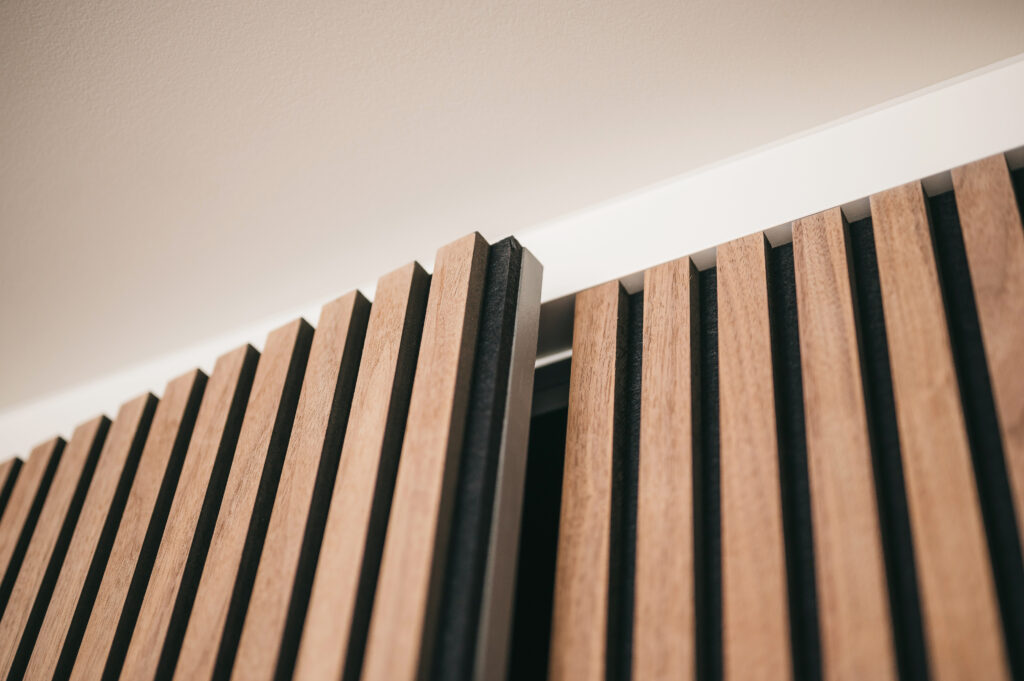
An acoustic panel is a frame of sound-absorbing material that is mounted on a wall or ceiling. They are usually made up of compressed fiberglass, mineral wool, or dense acoustic foam and wrapped in fabric. The absorptive core is porous, and its porosity is the whole trick. Sound waves enter the material, rattle around inside it, and lose their energy as tiny amounts of heat instead of bouncing back into the room.
Panels come in a few different forms. Standard absorption panels are typically one to two inches thick and handle the mid and high frequencies where dialogue and detail live. Thicker panels and corner-mounted bass traps go after low frequencies, which carry far more energy and need more material to tame. Diffusers, the sculpted-looking cousins, scatter sound rather than absorb it. This keeps a room lively without letting echoes pile up. In a theater, panels usually land on the side walls at ear level, on the wall behind the speakers or seating, and sometimes on the ceiling.
How Do Acoustic Panels Work?
When your speakers play, only part of what you hear travels straight to your ears. The rest hits the walls, ceiling, and floor first, then arrives a few milliseconds late as a reflection. Your brain blends those late arrivals with the direct sound. This can smear dialogue, blur the placement of effects, and make bass sound boomy or thin depending on where you sit. Clap your hands in an empty room, and that metallic ring you hear is flutter echo.
Panels clean this up by intercepting the reflections that matter most, especially at the first reflection points, the spots on the side walls and ceiling where sound takes its first bounce between speaker and seat. There is even a low-tech way to find them: slide a mirror along the side wall while a helper sits in your seat, and wherever they can see a speaker in the mirror is a first reflection point. Panel performance is measured too. The industry-standard rating that describes it comes from a reverberation room test, which produces the NRC number you see on spec sheets, an average of how much sound a panel absorbs across the frequencies where speech and music live. An NRC of 0.90 means roughly ninety percent of the sound hitting the panel never comes back.
Acoustic Treatment vs Soundproofing
Here is the misunderstanding that costs homeowners the most money: acoustic panels do not stop sound from leaving the room. Treatment and soundproofing solve completely different problems. Treatment shapes how sound behaves inside the room so movies sound clear where you sit. Soundproofing blocks sound from traveling between rooms so an action movie at reference volume does not wake the kids upstairs.
Soundproofing works through mass, decoupling, and sealing. It’s known for heavier wall assemblies, isolated framing, insulation in the cavities, and airtight doors. Its effectiveness is measured by STC ratings on wall assemblies, and moving that number meaningfully means changing the construction of the room, not hanging fabric on it. A two-inch panel that soaks up an echo does almost nothing against bass thumping through a shared wall. If containing sound is the real goal, soundproofing your home theater is its own project and is best handled while the walls are open. Plenty of rooms need one, the other, or both, but you have to know which problem you are actually paying to solve.
Do You Actually Need Acoustic Panels?
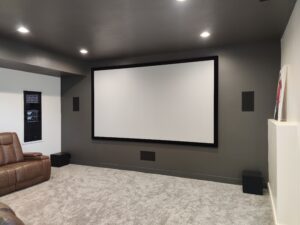
The honest answer is that it depends on the room. A dedicated theater with hard drywall surfaces, a big screen wall, and rows of seating almost always benefits, because those rooms are reflective by nature. It is no accident that the performance levels integrators design to treat acoustics as part of the audio system itself rather than an accessory.
The case gets stronger if you hear a distinct ring or slap echo when you clap, if dialogue sounds smeared unless you crank the center channel, or if the room is nearly symmetrical and bare. Acoustic panels are less necessary in a family media room that already has a thick rug, upholstered furniture, curtains, and full bookshelves, because those furnishings are doing a real fraction of the absorbing already. In that room, the first dollar is usually better spent on speaker placement, subwoofer positioning, and calibration, with treatment revisited once the fundamentals are set.
Panel coverage has drawbacks too, as treating every surface makes a room dead and unnatural. Well-designed theaters typically treat a modest share of the wall area at the points that matter, not the whole room.
What Else Shapes the Sound in Your Theater
Panels are one lever among several, and the others are free or close to it. Speaker placement comes first, since where each channel sits and aims determines how stable the center image is and whether surround effects land where the mixer puts them. Getting placement right during your home theater setup solves problems no panel can.
Room shape and dimensions matter just as much. Low frequencies interact with a room’s measurements to create spots where bass booms and spots where it vanishes, which is why moving a subwoofer or the seating a foot or two can outperform a purchase. Square rooms and rooms with the seat against the back wall fight you hardest, and small theater rooms come with their own playbook. Symmetry matters as well. A solid wall on one side and an open hallway on the other pulls the sound off center. Finally, furnishings are quiet allies. Carpets, drapes, and soft seating absorb real energy, which is why a furnished room sounds noticeably better than the same room empty, and why the panel question should always be answered after the room is furnished, not before.
Build a Theater That Sounds as Good as It Looks with AIS
A home theater lives or dies on how it sounds, and the room itself has more say in that than most people expect. Knowing what acoustic panels actually do, and what they cannot do, keeps you from spending on the wrong fix and lets you put the budget where the room will thank you for it. The real answer almost always comes from looking at the specific space, its dimensions, its surfaces, and how you plan to use it, rather than applying a rule of thumb from a forum post. AIS designs and installs custom home theaters throughout Northern Utah, treating acoustics as part of the design rather than an afterthought bolted on at the end. Contact us today to talk through your space, or use our budget calculator to start mapping out your build.