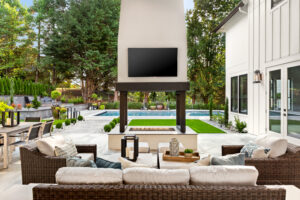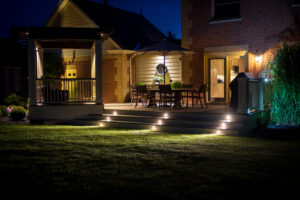

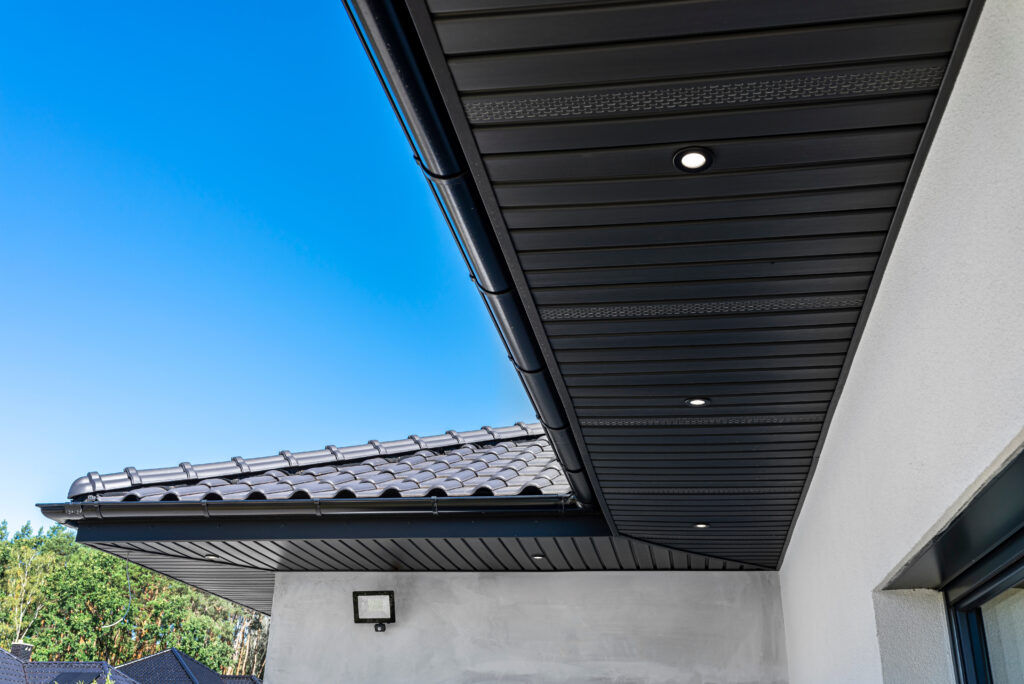
Soffit lighting is exterior lighting recessed into the underside of your roof overhang, aimed downward so it washes the face of the house in light rather than dotting it with visible fixtures. It exists because a home lit from above reads the way it does in daylight, with the architecture doing the work instead of the light fixtures. Most people stop there, but a few questions usually follow. Does it actually look good, or does it flatten everything out? How does it compare to landscape lighting at ground level? Is this something you can add to a house that already exists? Below, we cover what soffit lighting is, how it works, what it does for a home’s exterior, how it stacks up against the alternatives, and what to sort out before installation day. You will finish knowing whether it is the right approach for your home.
What Is Soffit Lighting?
The soffit is the flat underside of your roof overhang that bridges the gap between the edge of the roof and the exterior wall. Soffit lighting places fixtures, usually small recessed downlights or slim linear LEDs, into that surface so the light source sits flush and nearly invisible. All you see at night is a wash of light sliding down the siding, stone, or brick below.
That placement is what separates it from every other exterior option. Coach lights beside the garage and sconces at the front door are fixtures you are meant to see. Soffit lights are the opposite. They hide in the architecture and let the house itself become the visible object. Because the fixtures are located under the overhang, they are also shielded from most rain and snow, though anything mounted there still needs to be rated for damp outdoor conditions. On homes with deep eaves, gables, or covered entries, the soffit runs across the entire perimeter, which means the canvas for this technique is already built into the house.
How Does Soffit Lighting Work?
Whether the effect lands comes down to three design decisions, and this is where most DIY attempts go sideways.
1. The first is beam angle. A narrow beam placed close to the wall grazes the surface, dragging light across brick or stacked stone so every bit of texture throws a small shadow. A wider beam set farther from the wall washes it smoothly instead, which flatters flat siding and stucco. Choosing the wrong one is how you get either a flat, washed-out face or harsh scallops of light that call attention to themselves.
2. The second is spacing. Fixtures placed at consistent intervals produce even, overlapping pools of light. Stretch the spacing to save a few fixtures, and you get a picket fence of bright and dark stripes across the front of the house.
3. The third is color temperature, measured in kelvins. Exterior architectural lighting almost always belongs in the warm 2700K to 3000K range, which flatters wood, stone, and brick, and every fixture on the house should match. A single cool-white fixture in a row of warm ones is visible from the street. Modern LED fixtures make the whole system practical, sipping a fraction of the energy of older halogen floods and lasting long enough that fixtures tucked twenty feet up a soffit rarely need attention.
Nailing these three design factors will give soffit lighting the best aesthetic effect.
What Soffit Lighting Does for Your Home’s Exterior
It Gives the House Its Daytime Presence Back
After dark, most homes disappear behind a porch light and a couple of windows. Downlighting from the roof restores the shape of the house, because light falling from above is the direction our eyes expect.
It Builds Curb Appeal That Works Nights Too
Curb appeal is not a soft benefit. Nearly all real estate agents say curb appeal matters to buyers, and landscape lighting projects earn some of the highest homeowner satisfaction scores of any outdoor upgrade. A house that presents beautifully at 9 p.m. is making that impression every single evening, not just when the sun cooperates.
It Adds Light Without Adding Glare
Because every fixture points down and the source is tucked under the overhang, soffit lighting brightens entries, walkways, and the perimeter of the home without floodlight glare. Aiming light only where it is needed is the core of responsible outdoor lighting, and downlighting from the roofline is one of the few techniques that delivers drama and restraint at the same time.
Soffit Lighting vs Other Exterior Lighting Options
Uplighting is the classic alternative: ground-mounted fixtures that throw light up tree trunks, columns, and facades. It is dramatic precisely because it inverts what daylight does, and the best exteriors use it sparingly on a few features rather than across the whole house. Soffit downlighting and uplighting are not rivals so much as layers, with downlight carrying the field and uplight providing the punctuation.
Path lighting works at ground level to guide movement along walkways and garden beds. It does its job well but does nothing for the house itself, and a yard lit only by path lights feels like a runway leading to a dark building. Wall-mounted sconces and coach lights add character and a human-scale glow at doors and garages, but they are jewelry, not illumination. If you are weighing the full menu, our landscape lighting ideas guide walks through the fixture types in more detail.
Can Soffit Lighting Work with a Smart Home?
Easily, and this is where the technique earns its keep long after installation. Wired into a smart lighting control system, soffit lights can follow an astronomical clock, coming on at sunset and stepping down late in the evening without you touching a switch. Platforms like Lutron let the exterior join whole-home scenes, so “Goodnight” dims the facade to a soft security level while “Entertain” brings the front of the house up to full presence for guests.
Integration also solves the control problem that plagues exterior lighting, where switches end up scattered across the garage and hallway. When landscape lighting joins your smart home system, the soffit lights, uplights, and path lights all live in one app with schedules, vacation modes, and dimming per zone. Planned as part of a broader home automation design, the exterior stops being an afterthought and becomes another room the system manages.
Design Your Exterior Lighting with AIS
Good exterior lighting is not about how many fixtures you can see; it is about how the house looks once you cannot see any of them. Understanding how soffit lighting works gives you the vocabulary to ask for what you actually want instead of settling for whatever gets installed. The difference between a house that is lit and a house that is designed comes down to layering, beam control, and restraint, which is where an experienced designer earns their keep. AIS designs and installs landscape lighting and smart lighting control for homeowners across Northern Utah, building exterior systems that look effortless because the planning happened first. Contact us today to talk through your home exterior lighting, or use our budget calculator to get a sense of what your project might look like.